
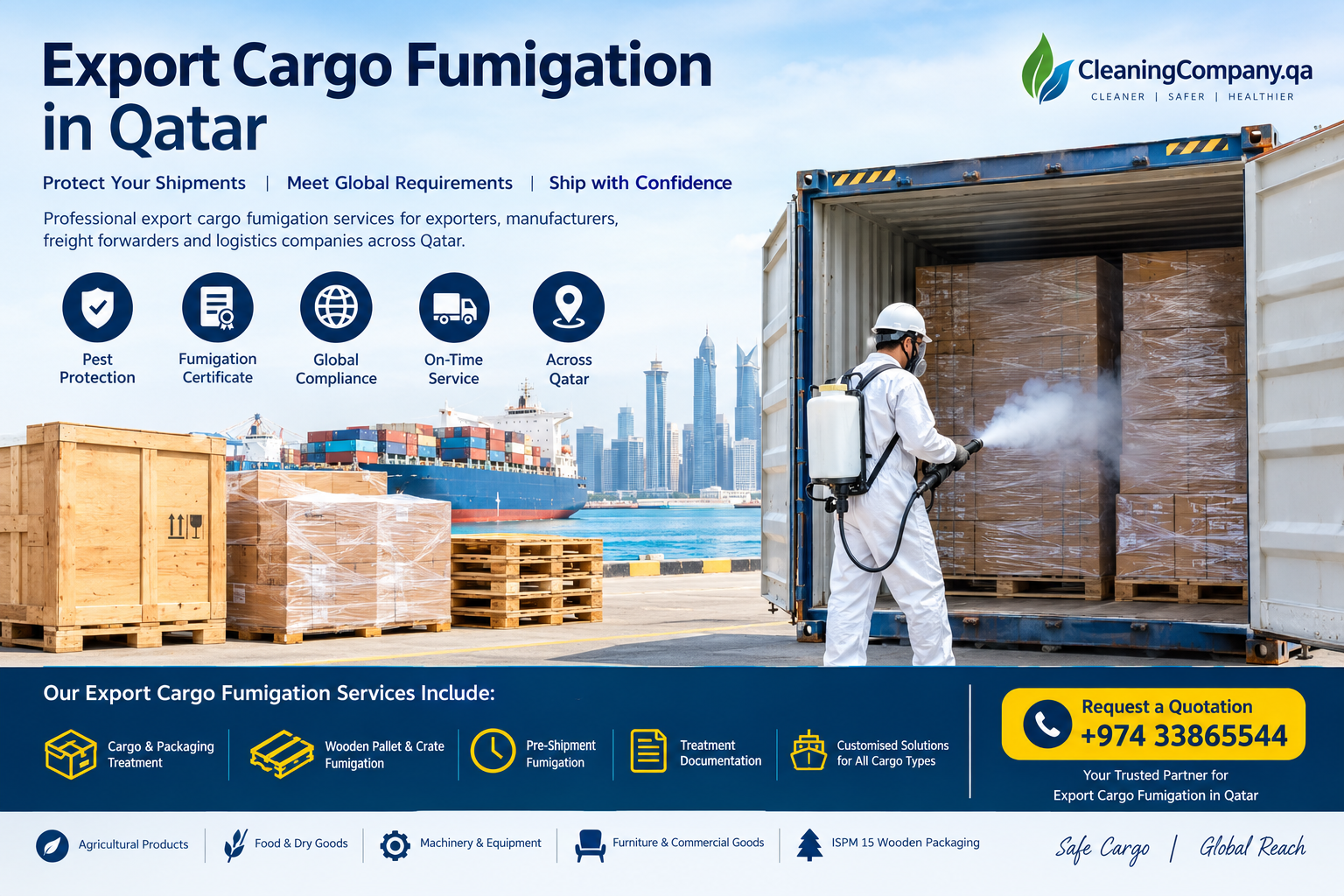
Export Cargo Fumigation in Qatar
Export cargo can be exposed to insects, termites and other pests during storage, packing, loading and international transportation. For exporters shipping goods from Qatar, appropriate cargo fumigation and pest treatment can help protect consignments and support destination-country requirements.
Thank you for reading this post, don't forget to subscribe!Export Cargo Fumigation in Qatar is a specialized service for exporters, manufacturers, freight forwarders, logistics companies, trading businesses, warehouses and shipping companies that need cargo treated before international dispatch.
CleaningCompany.qa provides professional export cargo fumigation solutions for eligible shipments across Qatar, with treatment planning based on the cargo type, packaging, container status, destination requirements and shipment schedule.
Professional Export Cargo Fumigation in Qatar
Export fumigation is not simply about treating a container with chemicals. The correct treatment approach depends on what is being shipped, how the cargo is packaged, where it is stored, whether wooden packaging is used and what requirements apply at the destination.
Before treatment, important information can include:
-
Type of cargo
-
Quantity and volume
-
Packaging materials
-
Wooden pallets or crates
-
Container size
-
Container number
-
Loading status
-
Export destination
-
Planned shipment date
-
Required documentation
-
Specific buyer or destination requirements
Providing accurate shipment information helps determine the appropriate treatment and documentation requirements.
Why Export Cargo Fumigation Matters
International cargo can pass through multiple environments before reaching the final destination. A pest issue that begins in a warehouse, pallet, wooden crate or container can create problems during transportation or at destination inspection.
Professional cargo fumigation can help exporters:
-
Reduce pest risks
-
Protect cargo during transportation
-
Address pest activity before dispatch
-
Support destination requirements
-
Protect wooden packaging
-
Reduce the risk of shipment delays
-
Maintain better cargo hygiene
-
Obtain treatment documentation where applicable
The exact requirement varies according to the cargo, packaging and destination country.
What Is Export Cargo Fumigation?
Export cargo fumigation is a controlled pest-treatment process used for certain goods, packaging materials or enclosed cargo environments before international shipment.
The treatment is planned according to the commodity, volume, enclosure, temperature, treatment requirements and applicable safety procedures.
Unlike ordinary surface pest treatment, fumigation is intended to reach pests that may be hidden within suitable cargo spaces or packaging.
The treatment method should always be selected by qualified professionals according to the cargo and applicable requirements.
Export Cargo Fumigation vs Container Fumigation
These terms are related but can describe different service requirements.
Container fumigation generally refers to treatment of an enclosed shipping container.
Export cargo fumigation focuses more broadly on the shipment itself, including the cargo, packaging, loading condition and export documentation requirements.
A cargo shipment may require treatment before container loading, after loading, or as part of a destination-specific export requirement.
This is why exporters should provide complete shipment details before arranging treatment.
Types of Export Cargo That May Require Fumigation
The treatment requirement depends on the commodity and destination.
Potential cargo categories include:
Agricultural Products
Agricultural products can have specific phytosanitary and quarantine considerations.
Examples may include:
-
Grains
-
Seeds
-
Agricultural commodities
-
Plant-related products
-
Food products
-
Dried agricultural goods
Requirements should always be confirmed for the specific destination and commodity.
Food and Dry Goods
Certain food-related cargo may require pest treatment depending on the product, packaging, destination and applicable regulations.
Examples can include:
-
Rice
-
Flour
-
Pulses
-
Cereals
-
Spices
-
Dried food products
-
Packaged commodities
Cargo treatment should be planned carefully so that the treatment method is suitable for the specific shipment.
Wooden Pallets
Wooden pallets can be associated with international pest-management requirements.
Exporters should distinguish between ISPM 15 wood-packaging requirements and a separate cargo fumigation requirement. ISPM 15 applies to qualifying solid-wood packaging material and involves treatment and marking requirements; it does not automatically mean that every shipment needs a separate cargo fumigation certificate.
Wooden Crates and Boxes
Wooden crates and boxes used for international shipments may require treatment or compliance measures depending on their material and destination.
Before shipment, exporters should verify whether the packaging requires an ISPM 15 treatment mark, additional fumigation or other documentation.
Machinery and Industrial Equipment
Machinery exported in containers may be exposed to pest contamination through wooden supports, pallets, crates, storage environments and packing materials.
Inspection can help identify whether wooden packaging or the cargo environment presents a treatment requirement.
Furniture and Commercial Goods
Furniture and other commercial products may be shipped using wooden pallets, crates or timber supports. These materials can create additional pest-management considerations during international transportation.
Export Fumigation for Wooden Packaging
Wooden packaging is an important consideration in international trade.
Export shipments may use:
-
Wooden pallets
-
Wooden crates
-
Timber supports
-
Dunnage
-
Wooden frames
-
Packing blocks
Qualifying solid-wood packaging is commonly subject to ISPM 15 requirements in international trade. The International Plant Protection Convention provides the international framework for these phytosanitary measures. Qatar is an IPPC contracting country with a designated plant-protection contact point.
Exporters should confirm the destination country’s current requirements rather than assuming that one treatment or document applies to every shipment.
ISPM 15 and Export Cargo Fumigation
ISPM 15 is an important international standard concerning wood packaging material used in international trade.
It covers qualifying raw wood packaging such as:
-
Pallets
-
Crates
-
Dunnage
-
Packing cases
-
Timber supports
However, ISPM 15 compliance and cargo fumigation are not automatically the same thing.
A destination may require compliant wood packaging markings, while a particular shipment may separately require fumigation or other treatment documentation.
For this reason, exporters should confirm the exact requirement with their buyer, freight forwarder, destination authority and treatment provider before shipping.
Export Fumigation Certificate in Qatar
Some export shipments may require documentation confirming that a treatment has been performed.
A fumigation certificate may contain information such as:
-
Exporter details
-
Consignee information
-
Cargo description
-
Container number
-
Treatment date
-
Treatment location
-
Treatment details
-
Quantity or volume
-
Applicable treatment information
-
Certification details
The precise contents and acceptance of documentation depend on the destination and applicable requirements.
A fumigation certificate should not automatically be treated as a substitute for other documents such as a phytosanitary certificate or required ISPM 15 marking.
The U.S. Department of Commerce, for example, distinguishes a fumigation certificate from the ISPM 15 marking system for qualifying wood packaging.
Pre-Shipment Fumigation for Export Cargo
Timing is important when arranging export cargo fumigation.
Treatment may need to be coordinated with:
-
Cargo packing
-
Warehouse release
-
Container loading
-
Customs procedures
-
Freight-forwarding arrangements
-
Port delivery
-
Vessel schedules
-
Destination documentation
Arranging treatment too late can create unnecessary pressure when a vessel or transport schedule is approaching.
Exporters should therefore provide the shipment details as early as possible.
Fumigation Before Container Loading
Some cargo or packaging may be treated before being loaded into the export container.
This can be relevant when:
-
Wooden packaging requires treatment
-
Cargo has been stored for an extended period
-
Pest activity is identified
-
The buyer requests treatment
-
Destination requirements specify treatment
-
Packaging requires pest-control measures
The correct sequence depends on the cargo and treatment requirements.
Fumigation of Loaded Export Containers
Where treatment is required after loading, the container may be treated as a controlled enclosure under an appropriate professional procedure.
The service team may need information about:
-
Container type
-
Container size
-
Cargo volume
-
Cargo arrangement
-
Packaging
-
Ventilation characteristics
-
Container condition
-
Treatment location
The container should be handled according to professional safety procedures and the applicable treatment requirements.
Export Cargo Inspection Before Fumigation
A pre-treatment assessment helps determine whether fumigation is appropriate.
The inspection may review:
-
Cargo type
-
Packaging
-
Wooden materials
-
Pest evidence
-
Storage history
-
Container condition
-
Loading condition
-
Access points
-
Destination requirements
This helps avoid applying an unsuitable treatment to cargo that requires another type of certification or treatment.
Export Fumigation for Freight Forwarders
Freight forwarders often coordinate multiple stages of an international shipment.
A reliable fumigation provider can help forwarders coordinate treatment around:
-
Cargo readiness
-
Container availability
-
Loading schedules
-
Documentation
-
Transport arrangements
-
Export deadlines
Early communication is particularly useful when the shipment has a fixed vessel or delivery schedule.
Export Fumigation for Logistics Companies
Logistics companies may handle cargo at warehouses, consolidation facilities and loading yards before international transportation.
Pest exposure can occur when cargo is:
-
Stored
-
Consolidated
-
Repacked
-
Loaded
-
Transferred between facilities
-
Held before dispatch
A structured treatment plan can help logistics operators manage pest risks at appropriate stages.
For businesses requiring broader warehouse support, industrial warehouse floor maintenance in Qatar can complement cargo hygiene and storage-area maintenance.
Export Cargo Fumigation for Manufacturers
Manufacturers exporting products from Qatar may use wooden pallets, crates, boxes or other packing materials.
Before shipment, exporters should consider:
-
Packaging condition
-
Wooden packaging requirements
-
Cargo storage conditions
-
Pest exposure
-
Destination requirements
-
Documentation
-
Container loading schedule
Early planning can reduce the risk of last-minute treatment requirements.
Export Cargo Fumigation for Trading Companies
Trading companies frequently handle different categories of goods and may export products from multiple suppliers.
Because requirements can vary by product and destination, shipment-specific assessment is important.
A previous shipment’s documentation should not automatically be copied for a new cargo movement without confirming that the destination and product requirements remain the same.
Cargo Fumigation for Qatar Exporters
Exporters operating from Qatar may ship cargo through logistics facilities and ports before reaching destinations across the Middle East, Asia, Africa, Europe and other international markets.
Treatment requirements can vary according to:
-
Destination country
-
Commodity
-
Packaging
-
Shipping method
-
Importing-country regulations
-
Buyer requirements
-
Quarantine requirements
For plant and agricultural shipments, Qatar’s official phytosanitary certification system includes treatment information such as treatment date, concentration, active ingredient and duration/temperature where applicable.
Cargo Fumigation and Phytosanitary Requirements
Fumigation and phytosanitary certification should not automatically be treated as identical.
A phytosanitary certificate is issued within the plant-health certification framework, while fumigation is a treatment that may form part of an importing country’s phytosanitary requirements.
Qatar’s official export phytosanitary certificate includes a section for disinfestation and/or disinfection treatment.
Exporters of agricultural and plant-related products should therefore verify the destination requirements before arranging treatment.
Export Cargo Fumigation for Food Products
Food-related export cargo requires careful consideration of the commodity, packaging and destination requirements.
Potential cargo includes:
-
Rice
-
Flour
-
Pulses
-
Cereals
-
Spices
-
Dried foods
-
Processed food products
-
Animal feed
The appropriate treatment must be determined according to the specific commodity and applicable requirements.
Export Cargo Fumigation for Agricultural Shipments
Agricultural shipments may face additional quarantine controls because importing countries can regulate pests associated with plant products.
Depending on the commodity and destination, exporters may need to coordinate:
-
Inspection
-
Treatment
-
Phytosanitary documentation
-
Packaging compliance
-
Cargo preparation
-
Export scheduling
Destination-country requirements should always be confirmed before shipment.
Fumigation for Export Cargo Stored in Warehouses
Cargo may remain in storage before container loading, increasing the importance of warehouse pest management.
Potential risk areas include:
-
Storage floors
-
Pallets
-
Wooden packaging
-
Loading zones
-
Receiving areas
-
Dispatch areas
-
Waste zones
-
Product storage areas
Where pest activity exists in the storage environment, exporters may need to address the warehouse as well as the shipment.
For broader storage protection, professional warehouse pest management in Qatar can support the prevention side of an export-cargo pest programme.
Export Cargo Fumigation and Cargo Protection
The objective of export fumigation is not simply to eliminate visible insects.
A properly planned programme can help reduce risks associated with:
-
Hidden pests
-
Pest contamination
-
Wooden packaging
-
Storage exposure
-
Container contamination
-
International transportation
-
Destination inspection
Treatment should always be based on the actual cargo and applicable requirements.
Export Cargo Fumigation Process
A typical service process can involve:
Shipment Information
The exporter provides details about the cargo, packaging, destination and shipping schedule.
Assessment
The treatment provider reviews the cargo and determines whether fumigation is appropriate.
Preparation
The cargo or container is prepared according to the selected treatment procedure.
Treatment
The fumigation is carried out under controlled professional conditions.
Safety and Clearance
The treated area is managed according to the applicable safety and clearance procedures before it is released for the next stage.
Documentation
Where applicable, treatment documentation or a fumigation certificate is issued based on the completed service.
Shipment
The exporter proceeds with the shipment according to the applicable logistics and destination requirements.
Why Professional Export Cargo Fumigation Is Important
International shipments involve multiple parties and regulatory requirements. Using an experienced fumigation provider can help exporters coordinate treatment with their shipping schedule and cargo requirements.
Professional service can provide:
-
Cargo assessment
-
Treatment planning
-
Controlled fumigation
-
Professional safety procedures
-
Treatment documentation where applicable
-
Export scheduling support
-
Cargo-specific recommendations
-
Follow-up coordination
The exact service depends on the cargo, packaging, destination and required treatment.
Common Export Fumigation Mistakes
Exporters can encounter problems when they:
-
Arrange treatment too late
-
Assume every destination has the same requirements
-
Confuse ISPM 15 with general cargo fumigation
-
Use untreated wooden packaging
-
Fail to provide complete cargo information
-
Ignore packaging condition
-
Wait until the container is already at the port
-
Assume a previous certificate is valid for a new shipment
-
Do not confirm requirements with the buyer or destination authority
Proper planning can reduce these risks.
How to Prepare Cargo for Fumigation
Before treatment, exporters should provide accurate information about:
-
Cargo description
-
Quantity
-
Packaging
-
Wooden materials
-
Container details
-
Destination
-
Shipping date
-
Existing documentation
-
Buyer requirements
Do not open, move or reconfigure treated cargo unless instructed by the responsible professionals.
Export Cargo Fumigation Across Qatar
CleaningCompany.qa provides export cargo fumigation support for businesses across Qatar, subject to cargo requirements, treatment conditions and service availability.
Service enquiries can come from exporters and logistics businesses in:
-
Doha
-
Industrial Area
-
Al Rayyan
-
Lusail
-
Al Wakrah
-
Mesaieed
-
Umm Salal
-
Al Khor
-
Other commercial locations across Qatar
For time-sensitive export shipments, provide the cargo and shipment information as early as possible so the treatment requirements can be assessed.
Frequently Asked Questions
Professional Export Cargo Fumigation in Qatar
Exporters need more than a basic pest treatment when preparing cargo for international transportation. The cargo type, packaging, destination, container condition and documentation requirements can all influence the appropriate treatment approach.
CleaningCompany.qa provides professional Export Cargo Fumigation in Qatar for exporters, manufacturers, logistics companies, freight forwarders, trading businesses and other commercial customers.
Whether you are preparing agricultural products, food cargo, machinery, commercial goods, wooden crates or palletized shipments, provide the shipment details early so the appropriate fumigation requirements can be assessed.
Request an export cargo fumigation quotation by providing:
-
Cargo type
-
Cargo quantity or approximate volume
-
Packaging type
-
Container details, if available
-
Export destination
-
Treatment location
-
Required treatment date
Export cargo fumigation is a professional pest-treatment process used for certain cargo, packaging or enclosed shipment environments before international transportation.
No. The requirement depends on the cargo, packaging, destination, importing-country rules and buyer or shipping requirements.
No. ISPM 15 concerns qualifying wood packaging material used in international trade. A separate cargo fumigation requirement may apply depending on the shipment and destination.
Wooden packaging may require treatment and marking under applicable ISPM 15 requirements. Exporters should confirm the destination's current requirements before shipment.
Depending on the cargo and treatment requirements, professional fumigation can be performed in an appropriate enclosed container under controlled procedures.
Where a fumigation certificate is applicable to the service and shipment, treatment documentation can be provided. The exact documentation should be confirmed before treatment.
Some food and agricultural cargo may require pest treatment, but the appropriate method depends on the commodity, destination and applicable requirements.
Yes, where the cargo or packaging requires pre-loading treatment, the service can be planned around the loading schedule.
Useful information includes the cargo type, approximate volume, packaging, container details, destination, location and required treatment date.
As early as possible. Treatment may need to be coordinated with cargo readiness, documentation, loading, transport and vessel schedules.